Valley of the Kings: The Royal Burial Ground of Ancient Egypt
Hidden among the dramatic cliffs of the West Bank of Luxor lies one of the most extraordinary archaeological sites in the world—the Valley of the Kings. For nearly 500 years during Egypt’s New Kingdom period (c. 1550–1070 BC), this remote desert valley served as the final resting place of Egypt’s most powerful pharaohs. Today, it stands as a symbol of ancient Egyptian beliefs about the afterlife, royal power, and artistic achievement.
Why the Valley of the Kings Was Chosen
The Valley of the Kings was carefully selected for royal burials due to its isolated location, natural defenses, and religious significance. The valley sits beneath Al-Qurna, a pyramid-shaped mountain believed to symbolize rebirth and eternity. By abandoning pyramid tombs, which were vulnerable to looting, the pharaohs sought greater security by carving elaborate tombs deep into the limestone bedrock.
Architecture and Tomb Design
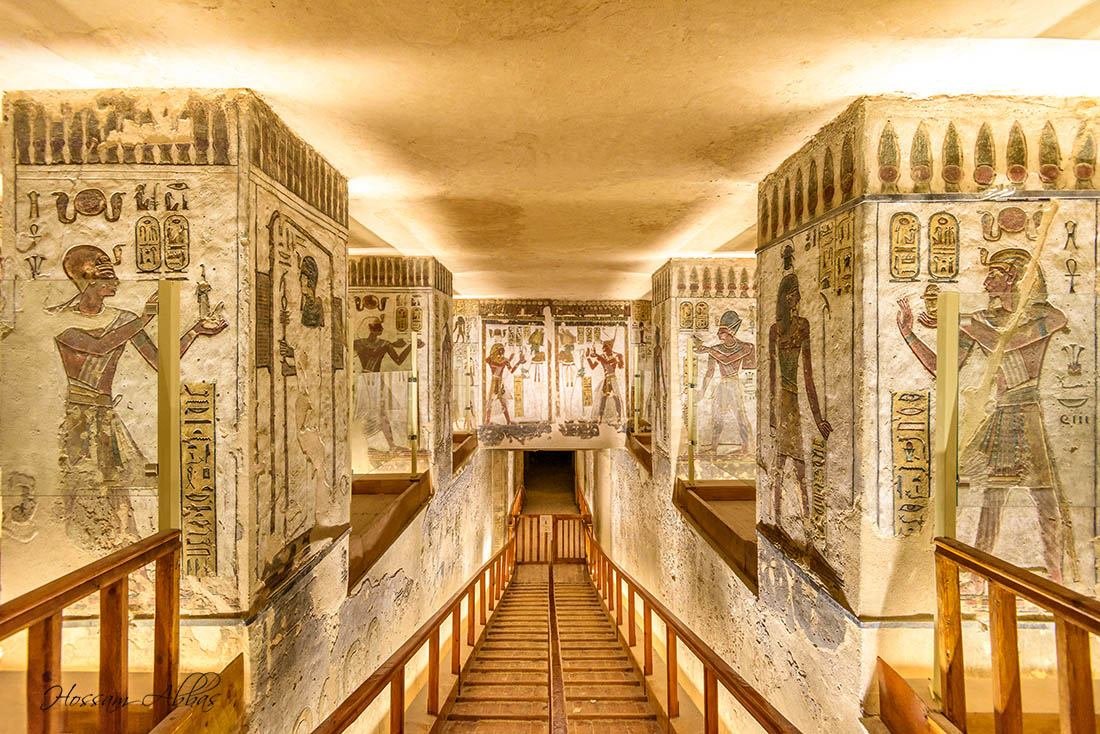
Unlike the towering pyramids of the Old Kingdom, ancient builders hid the tombs in the Valley of the Kings underground. Each tomb features a long descending corridor that leads to burial chambers, which artisans decorated with intricate wall paintings and hieroglyphic texts. Moreover, these artworks did not serve merely as decoration; they guided the pharaoh’s journey to the afterlife, following funerary texts such as the Book of the Dead, the Amduat, and the Book of Gates.
The tombs vary greatly in size and complexity. While some builders completed their tombs hastily, others—such as those of Seti I and Ramses VI—showcase masterpieces of ancient art and engineering.
Famous Pharaohs Buried in the Valley
The Valley of the Kings contains more than 60 known tombs, including those of some of Egypt’s most legendary rulers:
-
Tutankhamun (KV62) – Discovered in 1922 by Howard Carter, his nearly intact tomb revealed priceless treasures, including the iconic golden mask.
-
Seti I (KV17) – Considered one of the most beautifully decorated tombs in Egypt.
-
Ramses II (KV7) – One of Egypt’s longest-reigning and most powerful pharaohs.
-
Ramses VI (KV9) – Famous for its astronomical ceiling and vivid artwork.
Art, Religion, and the Afterlife
The wall paintings in the Valley of the Kings provide invaluable insight into ancient Egyptian religion. Scenes depict gods such as Osiris, Ra, Anubis, and Hathor, along with rituals designed to protect and resurrect the king. These images were believed to possess magical power, ensuring eternal life for the pharaoh.
The tomb ceilings often portray the night sky and solar journey, symbolizing rebirth and cosmic order. Colors remain remarkably vivid even after thousands of years, a testament to the skill of ancient Egyptian artisans.
Discovery and Archaeological Importance
Although many tombs were looted in antiquity, modern archaeologists have revealed the Valley of the Kings as one of the richest sources of information about ancient Egypt. For example, the discovery of Tutankhamun’s tomb revolutionized Egyptology and captured the world’s imagination. Moreover, excavations continue today, with archaeologists uncovering new chambers and artifacts, proving that the valley still holds many secrets.
Visiting the Valley of the Kings Today
The Valley of the Kings is one of the highlights of any Luxor West Bank tour. Visitors can explore several tombs, each offering a unique artistic and historical experience. In addition, special tickets allow access to premium tombs, while conservation teams actively preserve this UNESCO World Heritage Site for future generations.
Legacy of the Valley of the Kings
The Valley of the Kings represents the pinnacle of ancient Egyptian funerary tradition. Here, art, religion, and royal ambition converge beneath the desert cliffs of Luxor. Furthermore, the valley offers more than a burial ground; it provides a timeless testament to humanity’s quest for immortality and enduring legacy.

Leave a Reply