The Temple of Kom Ombo in Aswan – The Unique Double Temple of Egypt
The Temple of Kom Ombo in Aswan is one of Egypt’s most unusual temples because it is dedicated to two gods. As a result, it has a rare double design that attracts visitors from around the world.
The Meaning and History of Kom Ombo
The name Kom Ombo comes from the Arabic word Kom, which means mound or hill. Meanwhile, Ombo derives from the ancient Egyptian word Nubt, meaning the golden city. Although builders constructed an earlier temple here during the New Kingdom, architects built the current temple later. In fact, historians date it mainly to the Graeco-Roman Period, between 332 BC and 395 AD. Archaeologists discovered the earliest royal name here, belonging to Ptolemy VI from the 2nd century BC. Later, artisans completed most of the temple’s decoration under Ptolemy XII.
A Temple Dedicated to Two Gods
Kom Ombo Temple is dedicated to Sobek, the crocodile god, and Horus the Elder. For this reason, the temple has two identical halves instead of one central axis.
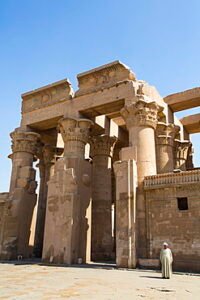
The temple dedicates the southern side to Sobek, while it assigns the northern side to Horus. As a result, architects designed separate halls, shrines, and sanctuaries for each god.
Sobek – God of Water and Fertility
Sobek, the god of the Nile, fertility, and the river’s annual flooding, ruled over life-giving waters. People worshipped him here alongside Hathor, the goddess of love and motherhood. Sobek and Hathor were joined by their son Khonsu, the moon god. This divine family emphasizes the importance of life, growth, and renewal.
Horus the Elder – God of Kingship at The Temple of Kom Ombo in Aswan
Horus the Elder ruled as the god of kingship, protection, and victory. People believed he was the son of Osiris and Isis and the ruler who defeated Seth. At Kom Ombo, worshippers honored Horus alongside his wife Tasentnefert, meaning the Perfect Companion. Their son Panebtawy, meaning Lord of the Two Lands, completed the divine family.
Wall Carvings and Medical Scenes in Kom Ombo Temple
In addition to its architecture, the temple features detailed wall carvings. For example, some scenes depict religious calendars and important festival dates. Most interestingly, artists carved ancient surgical instruments during the Roman period. Because of this, historians often link Kom Ombo to the advanced medical knowledge of ancient Egypt.
The Temple of Kom Ombo in Aswan is A Symbolic and Sacred Place
At the back of the temple, the artists depicted Sobek and Horus together in a powerful symbolic scene. Because of this, ancient visitors considered Kom Ombo a deeply sacred and balanced place. Today, visitors explore Kom Ombo Temple as one of Egypt’s most fascinating archaeological sites. It offers them a unique combination of history, religion, and architectural beauty.
Leave a Reply